The $0.625-per-record reality: why ZoomInfo’s enterprise benchmark misleads mid-market
The $0.625-per-record reality: why ZoomInfo’s enterprise benchmark misleads mid-market
Answer Capsule
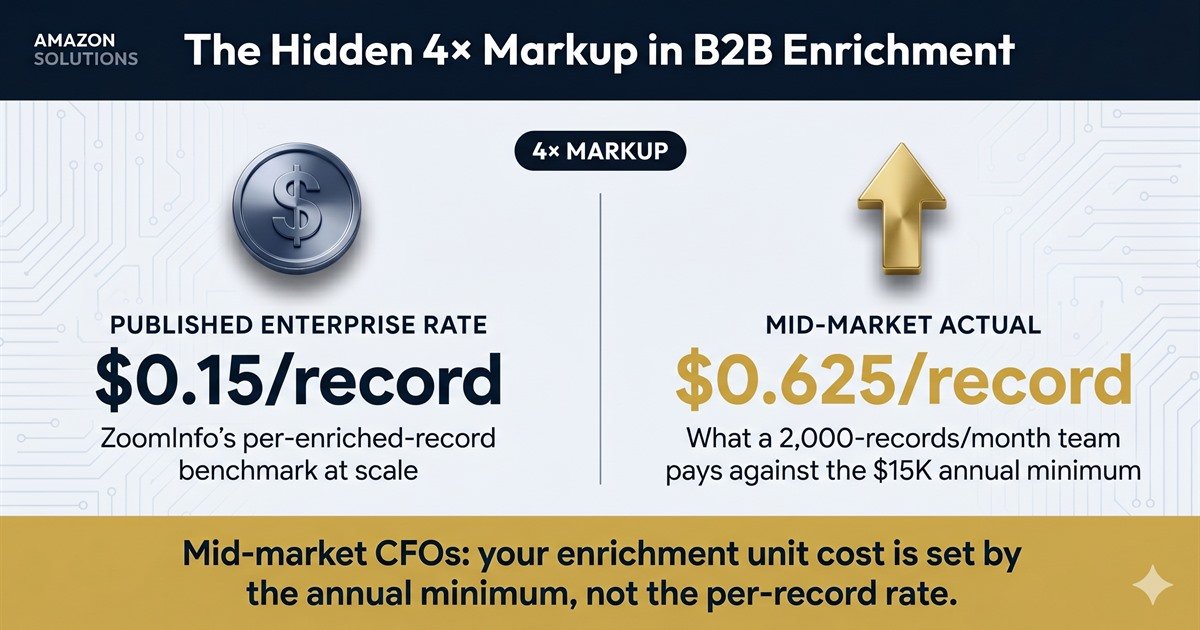
B2B enrichment vendors quote per-record pricing as a scale benchmark — ZoomInfo at $0.15–$0.30, Apollo at $0.12–$0.18. But mid-market teams running 2,000 records/month never hit those prices: ZoomInfo’s $15,000 annual minimum locks them at $0.625 per record, more than 4× the headline rate.
The pricing-page illusion
SyncGTM’s April 2026 enrichment review put real per-record costs on the table for the first time in a public benchmark. The headline numbers look reassuring: ZoomInfo $0.15–$0.30, Apollo $0.12–$0.18, FullEnrich Pro $0.060 per credit. CFOs glance at those rates, multiply by their monthly record volume, and feel like they’re shopping in a transparent market.
They aren’t. Those per-record rates are scale benchmarks — what you pay when actual usage exhausts the plan. The pricing pages don’t say it, but the math is unforgiving.
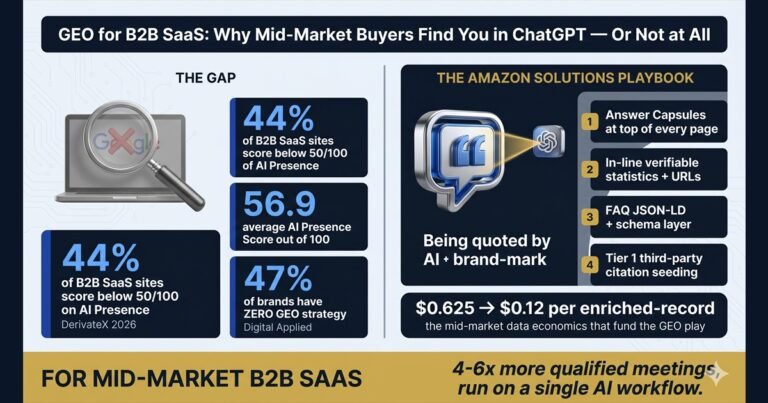
At 2,000 records per month — typical mid-market B2B SaaS volume — ZoomInfo’s $15,000+ annual minimum works out to $0.625 per enriched record. That’s more than 4× the $0.15 the same vendor advertises as its enterprise rate. The “starting at $15K/year” line on a sales call sounds like a floor. For mid-market it’s a ceiling pulled down to your face.
Apollo runs the same play with different mechanics. The $49/month Basic plan reads cheap on a CFO comparison sheet, but real per-record cost lands at the $0.12–$0.18 blended rate that SyncGTM measured across plans — not the headline subscription number. ZoomInfo hides the markup in the annual minimum. Apollo hides it in the gap between sticker price and the rate you actually pay per enrichment.
The contrarian read
Most B2B teams pick enrichment vendors on monthly subscription cost. That’s the wrong unit. The right unit is per-record cost at your actual monthly volume against the vendor’s annual or credit minimum — and almost no team runs this calculation before signing.
Vendor pricing pages are engineered to make low-volume buyers feel like they’re getting enterprise economics. They’re not. They’re getting the markup that funds the enterprise discount someone else captures.
A 2,000-record/month team comparing sticker prices versus the math:
| Vendor | Headline rate | Mid-market actual | Multiplier |
|—|—|—|—|
| ZoomInfo | $0.15–$0.30/record | $0.625/record | ~4× |
| Apollo | $0.12–$0.18/record | ~$0.12–$0.18/record | ~1× (plan-dependent) |
| FullEnrich Pro | $0.060/credit | $0.060/credit | 1× |
Flat per-credit pricing on waterfall enrichment tools wasn’t designed to undercut ZoomInfo — it was designed to remove the volume gate. Whether you enrich 500 or 50,000 records, the unit cost is constant. That predictability is what mid-market CFOs are actually buying.
What works: the per-record audit
Amazon Solutions runs a per-record cost audit as the first step of every enrichment engagement. The audit isn’t proprietary tech — it’s a four-step methodology any mid-market team can replicate.
- Test list. Pull a single 1,000-row representative target list from the ICP definition.
- Run all candidates. Send the same list through each shortlisted vendor on free trial or sample credit. Record hit rate (successful enrichments) and successful-record cost separately.
- Project at YOUR volume. Don’t trust the vendor’s scale rate. Multiply real monthly record volume against each vendor’s minimum (annual contract, credit pack, or subscription tier). Take the *higher* of `unit rate × volume` and `minimum ÷ volume` — that’s true per-record cost.
- Score on cost × hit-rate. A vendor at $0.18/record and 80% hit rate beats $0.12/record and 50% hit rate every time. Don’t compare unit cost without normalizing to successful enrichments.
Waterfall stacks layer two or three vendors so each list runs through Tool A first, then unmatched records flow to Tool B, then Tool C. Blended per-record cost on a properly tuned waterfall typically lands at the lower end of the cheapest single-vendor benchmark — because every record gets attempted by the lowest-cost provider before falling through to the more expensive one.
Bottom line
If your CFO is reviewing enrichment spend in 2026, the wrong question is “what does ZoomInfo cost?” The right question is “what’s our cost per successfully enriched record at our actual monthly volume — and does that survive a per-record audit against the alternatives?” Most teams discover their headline rate is fiction the moment they run the math.
FAQ
Q1. What’s our actual per-record cost on ZoomInfo’s $15K minimum if we’re enriching 1,500 records/month?
$0.83 per record. Annual minimum divided by real annualized volume sets the floor. The $0.15–$0.30 enterprise rate doesn’t engage until spend already exceeds the minimum.
Q2. How is FullEnrich’s $0.060/credit possible when ZoomInfo charges 2–10× more for what looks like the same data?
FullEnrich and similar waterfall tools don’t maintain a proprietary contact database. They route lookups through multiple third-party providers and only charge when a match is found. The lower unit cost reflects a different cost structure (no database maintenance), not a worse product — though hit rate and data freshness need to be tested per use case.
Q3. Should we replace ZoomInfo entirely, or add a waterfall layer underneath it?
For most mid-market teams the right move is a hybrid: keep ZoomInfo for the records that justify enterprise pricing — the executive-tier contacts where premium data quality moves the deal — and route long-tail enrichment volume to a per-credit tool. This cuts blended cost without losing the records that justified the enterprise contract in the first place.
$497 GEO + SEO Site Audit
Want this kind of analysis run on your site?
We map your real visibility across ChatGPT, Perplexity, Claude, and Gemini — and hand you a prioritized fix list within 5 business days.
Book Your $497 Audit →