GEO for B2B SaaS: How to Get Cited by ChatGPT, Perplexity, and Google AI Overviews
GEO for B2B SaaS: How to Get Cited by ChatGPT, Perplexity, and Google AI Overviews
Answer Capsule
Generative Engine Optimization (GEO) is the practice of structuring content so AI engines like ChatGPT, Perplexity, and Google AI Overviews quote it as a source. For mid-market B2B SaaS, this is now mission-critical: Forrester’s 2026 survey of 18,000 buyers found generative AI is the single most cited meaningful research source, yet 44% of B2B SaaS companies score below 50 on AI visibility benchmarks.
Most B2B SaaS Companies Are Optimizing for the Wrong Engine
Most B2B SaaS marketing teams are still ranking pages for Google. But mid-market buyers have already moved.
Forrester’s 2026 Buyer Insights — based on responses from nearly 18,000 global business buyers — reports that generative AI tools were the single most cited meaningful interaction type for researching purchases. Not vendor websites. Not analyst reports. Not sales reps. ChatGPT, Perplexity, Claude, and AI Overviews.
And the supply side hasn’t caught up. The DerivateX 2026 Benchmark Report tested 50 B2B SaaS companies across 1,400 buyer-intent prompts on ChatGPT, Perplexity, Claude, and Gemini. The findings:
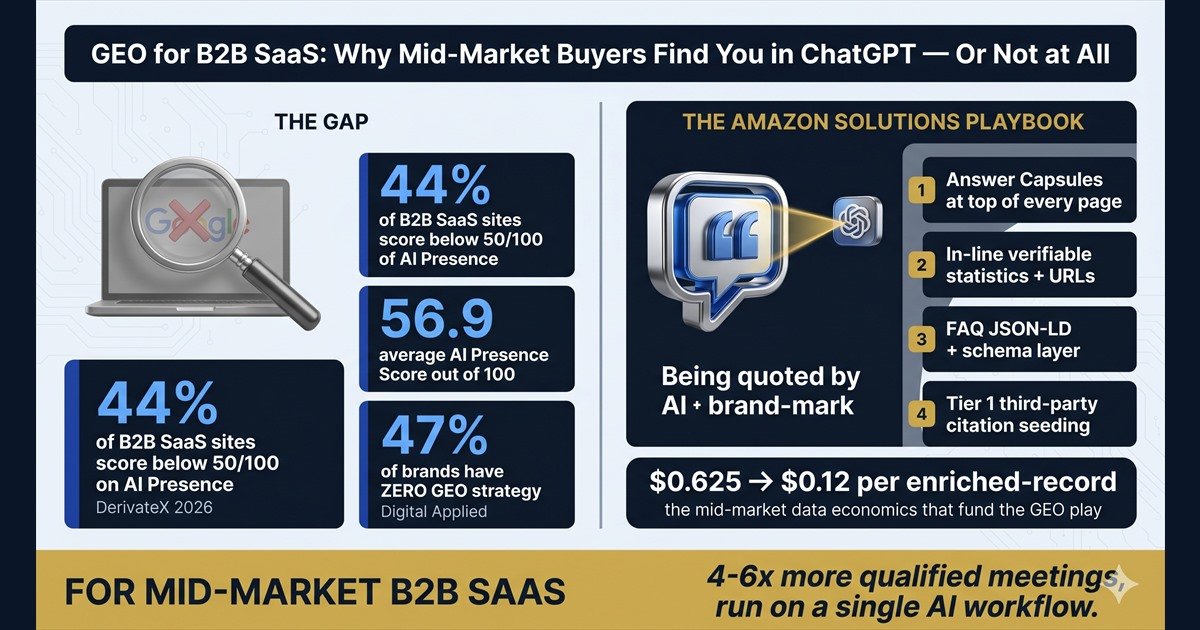
- Average AI Presence Score: 56.9 out of 100
- 44% of B2B SaaS companies score below 50 — effectively invisible when an AI engine answers a buyer’s question
- Highest scorer (Clio): 89. Lowest (LeadSquared): 2.
Meanwhile, Digital Applied’s 2026 GEO research finds 47% of brands have no GEO strategy at all.
This is the gap. Buyers ask AI. AI answers without you.
GEO Is Not SEO 2.0 — That Misread Is Costing Pipeline
The reflex move at most mid-market SaaS companies is: “we’ll add GEO to the SEO team’s backlog.” That assumption is wrong, and it’s the reason 44% of companies are still invisible.
SEO optimizes for ranking against a query. GEO optimizes for being quoted as fact. The mechanics diverge at every layer:
| Layer | SEO | GEO |
|—|—|—|
| Goal | Rank position | Citation extraction |
| Unit | The page | The answer-shaped paragraph |
| Authority | Backlinks | Source co-citation density |
| Win condition | Click | Brand mention in an AI answer (often zero-click) |
A page that ranks #1 on Google can be completely absent from ChatGPT’s answer for the same query, because the AI engine isn’t asking “what page ranks for this term.” It’s asking “what is the cleanest, most extractable answer with the most independent corroboration?”
That’s a different content brief, a different schema layer, and a different distribution strategy.
Amazon Solutions’ Mid-Market GEO Playbook
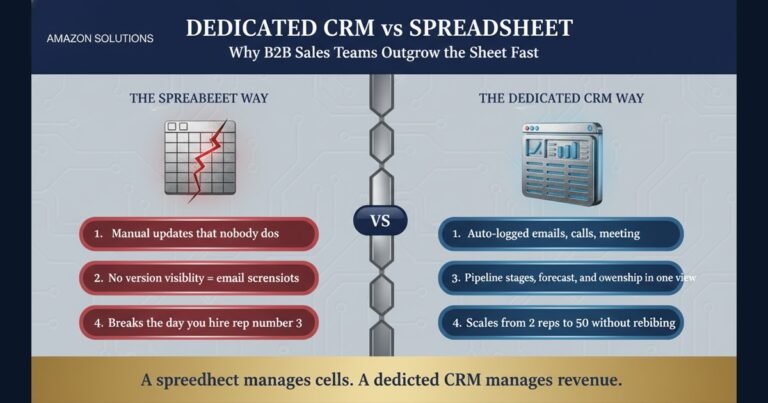
This is the same problem we already solved on the prospecting side: mid-market companies were buying enterprise tools (ZoomInfo at $15K/yr minimums, ~$0.625 per enriched-record) when an Apollo-class stack delivered the same data at $0.12 per enriched-record. The fix wasn’t a bigger budget. It was a stack that matched the mid-market.
GEO is the same pattern. Here’s the four-block playbook we run for clients:
1. Answer Capsules at the top of every page. A 40-60 word paragraph that gives definition → importance → data point. This is what AI engines extract verbatim. If it’s not there, you’re not being quoted.
2. Verifiable statistics with source URLs in-line. Princeton GEO research (cited by Digital Applied) shows citing sources lifts AI visibility by 40%, adding statistics by 37%, and including quotations by 30%. Compound those and you roughly double extraction probability.
3. Schema-first structure. FAQ JSON-LD, HowTo, Article, Organization — the structured-data layer is how AI Overviews disambiguate “who said what.”
4. Brand-mention seeding across Tier 1 third-party sources. AI engines weight independent co-citations more than self-promotion. We treat backlink-style outreach as a citation-supply problem.
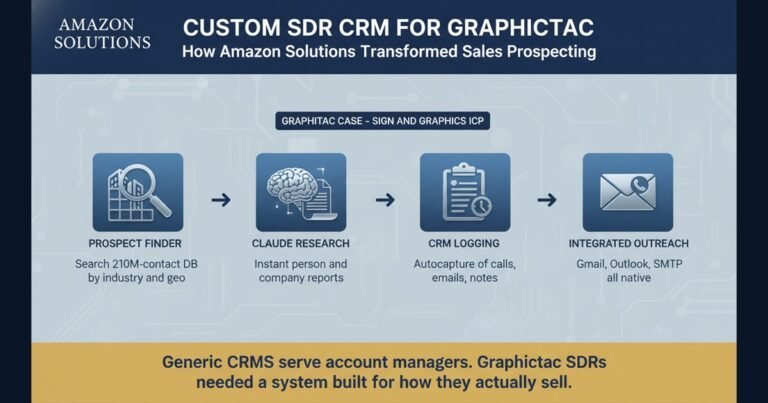
The same operational chassis behind our prospecting work — the workflow that gave GT Marketing a 210M-contact engine — runs the citation supply. Amazon Solutions delivers 4-6x more qualified meetings, with 1 BDR producing the output of 3-4 BDRs, by running a single AI-driven workflow against both pipelines: outbound contacts AND inbound citations.
That’s the unlock. GEO is not a content-team project. It’s a revenue-operations problem with a content surface.
FAQ
Q1. Will GEO replace SEO for B2B SaaS?
No. Both will coexist for 3-5 years. But the budget split is moving fast: Forrester’s 18,000-buyer survey identifies generative AI as the most meaningful research source, and Digital Applied data shows 47% of brands still have no GEO strategy. The companies that get there first capture the citation real estate before it gets contested.
Q2. How do I measure GEO performance if there’s no clicks?
You measure citations, not visits. Track: (1) mention rate across ChatGPT/Perplexity/Claude/Gemini for your top 30 buyer-intent prompts; (2) sentiment of those mentions; (3) position within the answer. DerivateX uses these to build an AI Presence Score out of 100 — the benchmark we run against for clients.
Q3. What’s the fastest way for a mid-market SaaS to get cited?
Three moves, in order: (1) add Answer Capsules to your top 10 pages this quarter, (2) add FAQ JSON-LD to every product and comparison page, (3) seed one Tier 1 third-party citation per month. Most mid-market companies see measurable lift in 6-8 weeks.
$497 GEO + SEO Site Audit
Want this kind of analysis run on your site?
We map your real visibility across ChatGPT, Perplexity, Claude, and Gemini — and hand you a prioritized fix list within 5 business days.
Book Your $497 Audit →