What Is a Sales Funnel? How B2B Companies Turn Strangers Into Customers
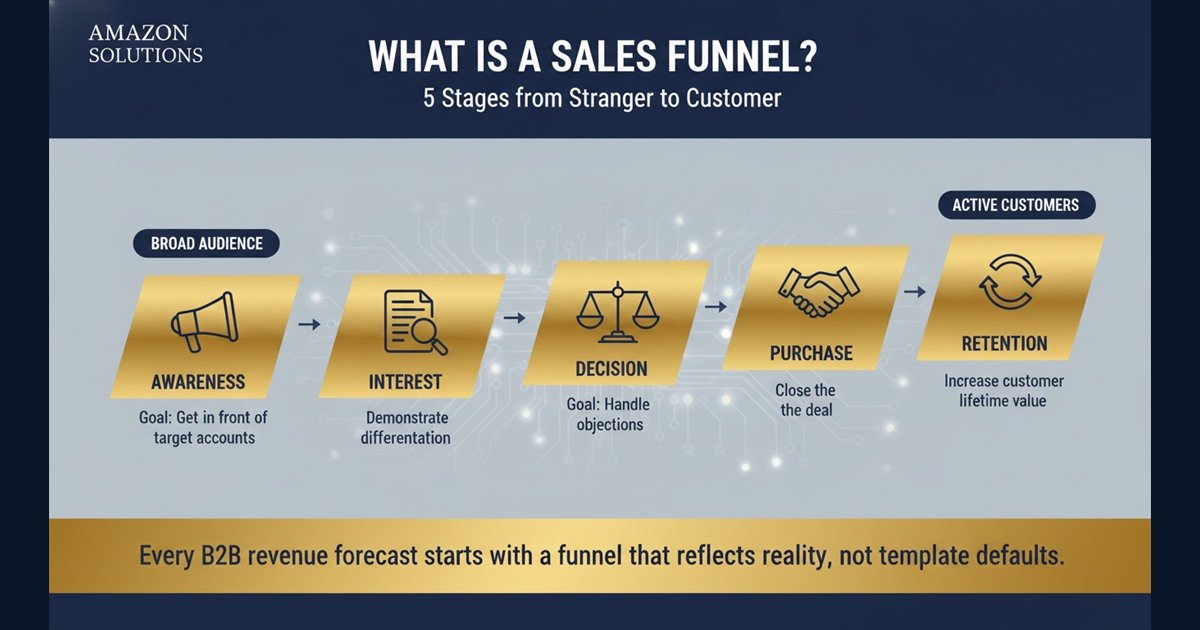
A sales funnel is the journey that a prospect takes from initial awareness of your company to becoming a paying customer. It visualizes how potential customers move through stages of your sales process, typically represented as a funnel shape that narrows as prospects move toward conversion.
Why Is the Sales Funnel Important for B2B Growth?
Understanding your sales funnel is critical for B2B growth because it reveals where prospects drop off, where your process is efficient, and where you’re losing revenue opportunity.
Key benefits:
- Visibility into the sales process (see where deals are moving or stuck)
- Predictability (forecast revenue based on pipeline stage distribution)
- Optimization opportunities (identify bottlenecks and improve conversion)
- Resource allocation (focus efforts where they matter most)
- Team alignment (sales, marketing, and operations understand the full journey)
The Traditional B2B Sales Funnel Stages
Most B2B funnels follow this structure:
1. Awareness – Prospects learn about your company and solution
- Target: Broad audience
- Goal: Get in front of your target accounts
- Tactics: Content, ads, PR, partnerships
2. Interest/Consideration – Prospects evaluate your solution
- Target: Prospects with recognized need
- Goal: Demonstrate relevance and differentiation
- Tactics: Product demos, case studies, comparisons
3. Decision – Prospects move toward purchase
- Target: Qualified leads ready to decide
- Goal: Handle objections, accelerate deal
- Tactics: Proposals, negotiations, proof of value
4. Purchase – Prospect becomes customer
- Target: Buyers with approved budget
- Goal: Close the deal
- Tactics: Final negotiations, contract, onboarding
5. Retention/Advocacy – Customer uses solution, recommends
- Target: Active customers
- Goal: Increase lifetime value
- Tactics: Support, upsells, case study generation
How to Optimize Each Stage of Your Sales Funnel
Modern B2B companies optimize their funnel by:
Stage 1: Awareness Optimization
- Use account-based marketing to reach target accounts
- Create content that solves prospect pain points
- Use AI to identify accounts showing buying signals
Stage 2: Interest Optimization
- Qualify leads early to avoid wasting time
- Provide personalized content based on prospect context
- Use multiple communication channels
- AI research helps personalize messaging at scale
Stage 3: Decision Optimization
- Create clear, ROI-focused proposals
- Accelerate sales cycles with efficient research
- Use proof of value to reduce perceived risk
- AI tools help build compelling business cases
Stage 4: Purchase Optimization
- Simplify contracting and legal reviews
- Reduce friction in final approval
- Clear next steps and timeline
Stage 5: Retention Optimization
- Proactive support and onboarding
- Regular business reviews
- Identify upsell and expansion opportunities
How AI Is Transforming the Sales Funnel
AI is making sales funnels more efficient at every stage:
- Awareness: AI identifies high-intent accounts automatically
- Interest: AI personalizes outreach based on research
- Decision: AI creates data-driven business cases
- Purchase: AI accelerates approvals with clear ROI
- Retention: AI predicts churn and expansion opportunities
Modern AI systems like Claude can:
- Research entire prospect accounts in minutes
- Identify buying signals across multiple data sources
- Generate personalized proposals
- Track funnel metrics and trends
- Predict which prospects are most likely to convert
Frequently Asked Questions About Sales Funnels
Q: What is a sales funnel?
A: A sales funnel is the journey that prospects take from initial awareness to becoming a paying customer. It visualizes how potential customers move through different stages of your sales process.
Q: How many stages should a sales funnel have?
A: Most B2B funnels have 4-6 stages: Awareness, Interest, Decision, Purchase, and sometimes Retention/Advocacy. The right number depends on your sales cycle length and deal complexity.
Q: What is a good conversion rate between funnel stages?
A: Conversion rates vary by industry, but typical B2B benchmarks are: Awareness to Interest (5-15%), Interest to Decision (20-40%), Decision to Purchase (50-80%). Top performers achieve 2-3x these benchmarks using AI research and qualification.
Q: How do we measure funnel health?
A: Track conversion rates between stages, average sales cycle length, pipeline value by stage, and win/loss rates. AI tools help automate this tracking and identify optimization opportunities.
Q: How can we speed up the sales funnel?
A: Focus on the longest stages. Typically, the Interest and Decision stages slow down deals. Personalized research, clear business cases, and AI-powered qualification accelerate these critical stages.
Build a Winning Sales Funnel
Ready to optimize your B2B sales funnel? Amazon Solutions helps revenue teams build funnels that consistently convert.
Using AI-powered sales research and qualification, we help you:
- Shorten sales cycles by 30-40%
- Increase conversion rates at each stage
- Reduce time spent on unqualified prospects
- Create data-driven proposals and business cases
Schedule a strategy call to see how we can improve your funnel metrics.
Related Resources
Learn more about related topics:
- What Is Sales Prospecting? – Fill your funnel with the right prospects
- What Is Lead Qualification? – Qualify leads to improve conversion rates
- What Is an SDR? – Meet the sales development representative role
- The Business Case Story – See funnel optimization in action
$497 GEO + SEO Site Audit
Want this kind of analysis run on your site?
We map your real visibility across ChatGPT, Perplexity, Claude, and Gemini — and hand you a prioritized fix list within 5 business days.
Book Your $497 Audit →