Why Your B2B Sales Team Needs a Dedicated CRM — Not a Spreadsheet
It starts innocently enough. A shared Google Sheet. A tab for each client. A column for follow-up dates. For a sales team of two or three people managing a handful of accounts, it works — just barely. But the moment your team grows, your pipeline expands, or your market gets more competitive, the spreadsheet stops being a tool and starts being a liability.
If your B2B sales team is still running on Excel or Google Sheets, this article is for you. Here’s why a dedicated CRM system isn’t a luxury — it’s the infrastructure your sales operation needs to scale.
The Spreadsheet Problem: What You’re Actually Losing
1. No Single Source of Truth
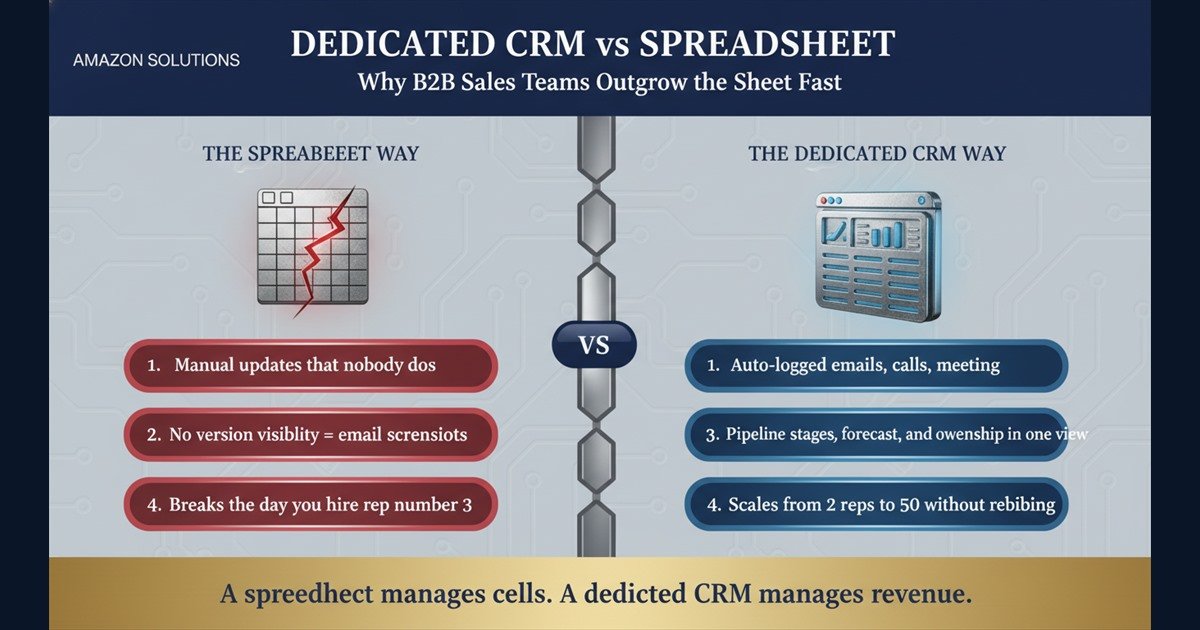
When your contact list lives in a spreadsheet, version control becomes a constant battle. Who has the latest copy? Did someone update that column? Did the follow-up date get changed? With multiple team members working from the same file — or worse, different versions of it — you end up with duplicated contacts, missed updates, and conflicting information. A CRM keeps every contact, note, and activity in one place, updated in real time, visible to the whole team.
2. No Activity Tracking
Spreadsheets track data — they don’t track conversations. A CRM records every call, email, meeting, and note linked to a specific contact and company. When a sales rep logs a call with a prospect, that activity is timestamped and stored. When a manager wants to know what happened with a particular account, they don’t need to ask — they can see the entire history in seconds. This level of accountability and transparency is impossible to replicate in a spreadsheet.
3. No Visibility Into the Pipeline
With a spreadsheet, your pipeline is only as current as the last person who updated it. A CRM gives you a live dashboard — how many contacts are in the pipeline, what stage each one is at, what follow-ups are due today, and which accounts have gone cold. For B2B sales managers overseeing multiple reps and hundreds of prospects, this visibility isn’t optional. It’s how you make decisions, set priorities, and hold your team accountable.
4. No Scalability
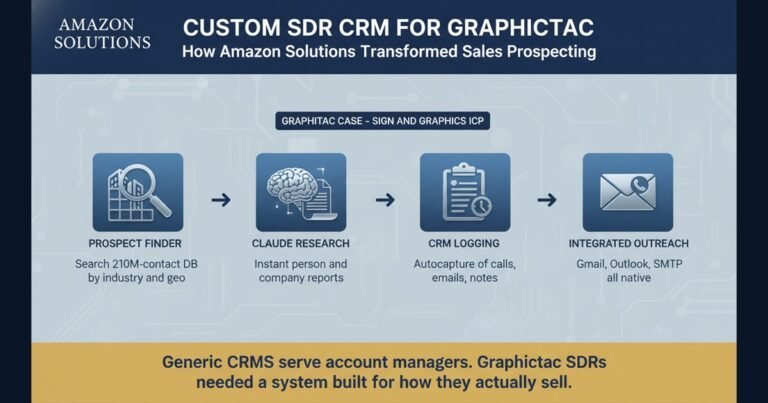
A spreadsheet that works for 50 contacts becomes unwieldy at 200 and completely unmanageable at 500. A CRM is built to scale — designed to handle thousands of contacts, dozens of users, and years of interaction history without slowing down or losing data. When Graphictac needed to manage 175+ contacts across a multi-rep team in the sign and graphics industry, no spreadsheet could have handled it. Their custom CRM from Amazon Solutions did — and continues to grow with them.
5. No Integration with Modern Sales Tools
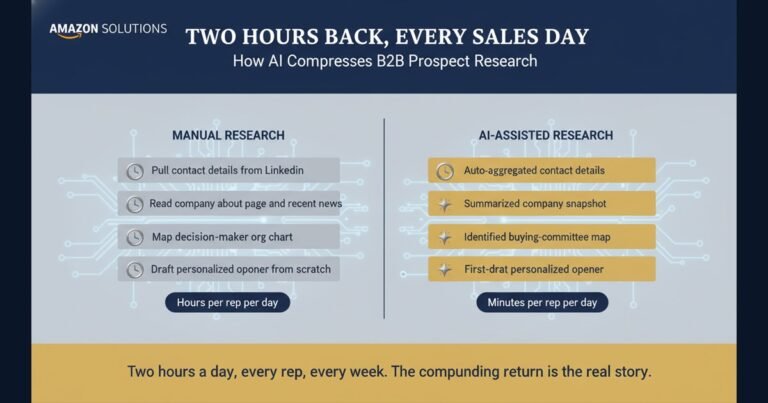
Today’s B2B sales workflows depend on tools that work together: email platforms, contact databases, AI research tools, call logging, follow-up automation. A spreadsheet can’t connect to any of these. A well-built CRM integrates all of them — so your team can send emails, import prospects, generate AI reports, and log activity without ever leaving the platform.
What a Dedicated CRM Actually Does for Your Team
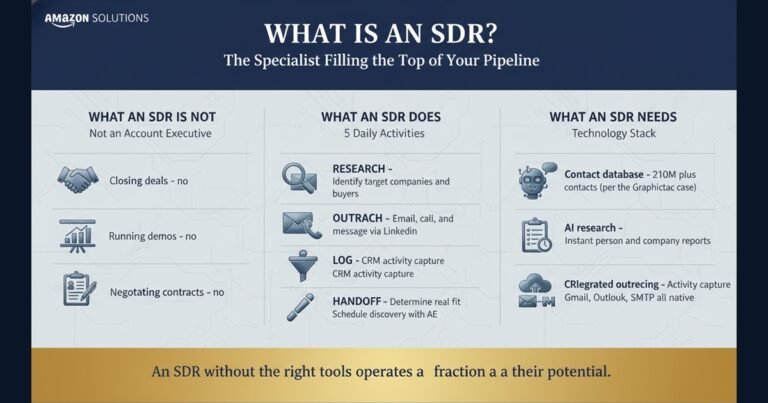
A custom CRM system built by Amazon Solutions gives your B2B sales team a centralized hub for every contact and company in your pipeline, with full profile data including email, phone, location, and website. Every interaction — calls, emails, notes, meetings — is logged and timestamped in a visible activity timeline. Managers get real-time visibility into what every rep is doing and which accounts need attention. AI-powered research reports on any contact or company are available on demand. Direct email integration means outreach happens inside the CRM, not outside it. And prospect discovery tools give reps access to a 210M+ contact database to find new leads in minutes.
The Cost of Waiting
Every month your sales team spends on a spreadsheet is a month of missed follow-ups, lost deals, and wasted research time. The data your team generates — conversations, contacts, insights — has real business value. A CRM captures and organizes that value. A spreadsheet lets it leak away.
The question isn’t whether your team needs a CRM. The question is how much longer you can afford to go without one. Amazon Solutions specializes in building custom CRM systems for B2B sales teams — systems designed around your workflow, your market, and your growth goals. Reach out today to find out what the right system looks like for your team.
$497 GEO + SEO Site Audit
Want this kind of analysis run on your site?
We map your real visibility across ChatGPT, Perplexity, Claude, and Gemini — and hand you a prioritized fix list within 5 business days.
Book Your $497 Audit →