Anthropic, Blackstone, and Goldman Just Bet on Mid-Market AI Services. Here’s What B2B Pipeline Teams Should Do First.
The announcement that just changed the math
On May 4, 2026, Anthropic announced it is co-founding a new enterprise AI services company with Blackstone, Hellman & Friedman, and Goldman Sachs, with additional backing from General Atlantic, Leonard Green, Apollo Global Management, GIC, and Sequoia Capital. The stated mandate: work with mid-sized companies across sectors to bring Claude into their most important operations. Eight days later, at SAP Sapphire on May 12, SAP and Anthropic announced that Claude will be embedded across SAP’s AI-enabled solution portfolio, powered by Joule and Joule agents. In the weeks before, Anthropic had already launched Claude Platform on AWS with native IAM and consolidated AWS billing. Three of the largest distribution surfaces in enterprise technology, all routing the same model into the same buyer inside an eight-day window.
Why this is the validation moment
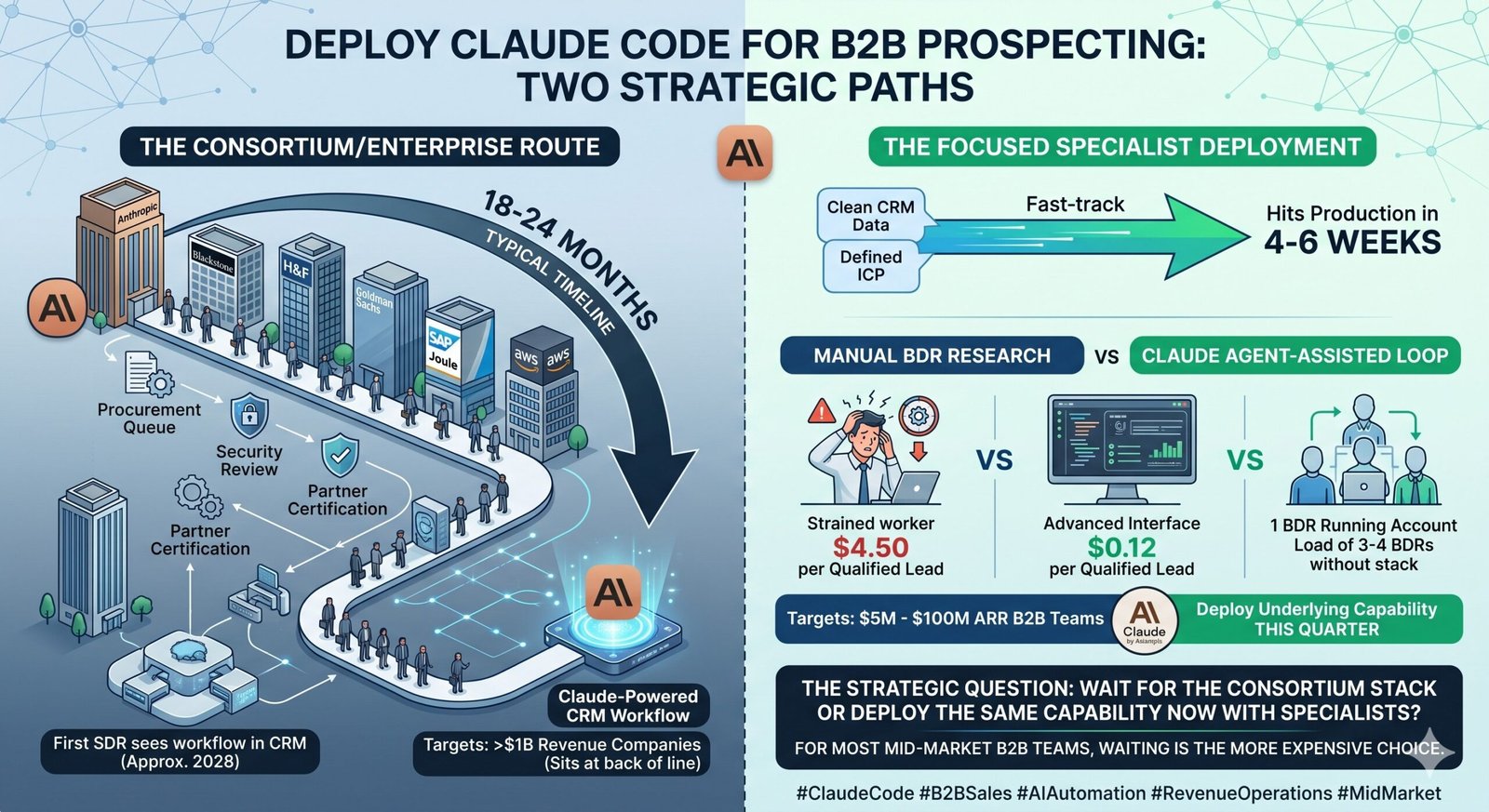
For anyone running B2B sales operations today, this is the validation moment for AI-native pipeline work — and a warning about the timeline gap between announcement and execution. A consortium-led services rollout into mid-market typically requires 18-24 months of procurement, security review, regulatory alignment, and integration partner certification before the first SDR sees a Claude-powered workflow inside their CRM. Companies above $1B revenue onboard first. The B2B sub-$100M segment — the same segment that benefits most from agent-led prospecting and qualification — sits at the back of the line. The market just got validated and consolidated at the top in the same press release.
The capability is already shipping
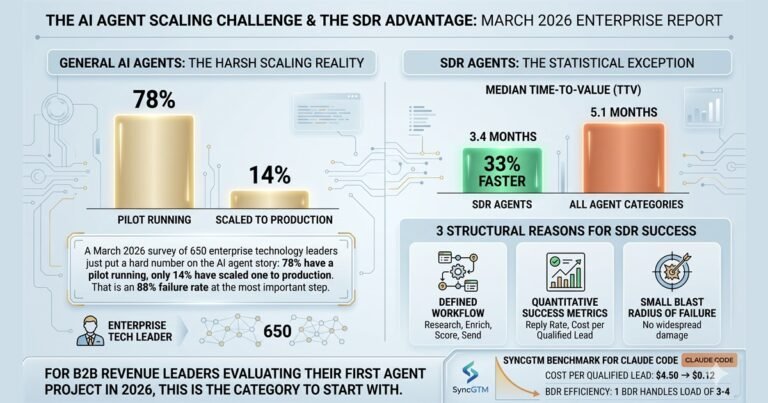
Meanwhile, the underlying technology is already in production. One published 2026 benchmark of Claude Code on outbound prospecting reports cost per qualified lead dropping from approximately $4.50 in manual BDR research to $0.12 in an agent-assisted loop — a 37× reduction that compounds across pipeline volume. The same benchmark documents that one BDR running the agent stack handles the account load of three to four BDRs without it. These are deployed metrics from production accounts, not projections, and they describe only the outbound prospecting workflow. Qualification, RFP response, and account research each have their own efficiency curves once an agent absorbs the manual labor.
None of this requires a consortium-managed rollout to access. The architecture is well-understood: a Claude Code agent that scrapes structured signals from LinkedIn job posts, G2 reviewer profiles, and company data sources; a waterfall enrichment cascade across 50+ providers to verify contact data; an ICP-aligned scoring function; and a write path into HubSpot or Salesforce. Add Clay or Apollo for enrichment, an outreach sequencer, and a deliverability monitor. The full loop runs in production inside 4-6 weeks for a focused B2B team with existing CRM hygiene and a defined ICP.
Where independent consultancies stay structurally relevant
This is where independent specialists remain the right buy for most mid-market B2B teams. Amazon Solutions is an independent B2B AI consultancy headquartered in California that builds exactly this stack for clients including GT Marketing and Graphictac. The engagement model is different from a consortium services company: a four-week pilot scoped against an existing CRM, a Claude Code agent shipped into production, and an honest measurement on whether the workflow returns 4-6× more qualified meetings per SDR before any retainer conversation. There is no procurement cycle behind the Fortune 1000, no integration partner certification queue, no waiting list. The work either moves the three numbers that matter — cost per qualified lead, reply rate, pipeline coverage — or the engagement is the wrong fit.
The strategic question for a B2B revenue leader in May 2026 is not whether AI-native pipeline work is real. Anthropic, Blackstone, Goldman, SAP, and AWS have collectively answered that question in the last 30 days. The question is whether to wait for the consortium stack to arrive in your CRM in 2028, or deploy the same underlying capability inside this quarter with a specialist who can point at production systems in similar-size accounts. For most B2B teams between $5M and $100M ARR, waiting is the more expensive choice.
A practical short list for revenue leaders
A short evaluation checklist for the next 90 days:
- Audit your CRM first. Any Claude Code agent inherits the data quality of the system it writes into. Bad ICP definitions and stale contact records produce bad output at agent scale.
- Pick one workflow, not five. Outbound prospecting and lead qualification are the two highest-ROI starting points in the 2026 benchmarks. Resist automating everything at once.
- Run a 4-week pilot with measurable exit criteria. Cost per qualified lead, reply rate, and pipeline coverage are the three numbers that determine fit. If they don’t move inside 60 days, the engagement is wrong.
- Pick a partner who deploys in production, not in slideware. Ask to see the repository structure, the CRM mappings, the monitoring dashboard. Anything else is theater.
The consortium has placed its bet. The next 24 months will reward the B2B teams that don’t wait for it to mature inside their stack.
Frequently Asked Questions
What is the Anthropic-Blackstone services company?
A new enterprise AI services company announced May 4, 2026, co-founded by Anthropic with Blackstone, Hellman & Friedman, and Goldman Sachs, plus participation from General Atlantic, Leonard Green, Apollo Global Management, GIC, and Sequoia Capital. The company’s stated mandate is to bring Claude into mid-sized enterprises’ core operations. Practically, it will compete with the existing Big 4 systems integrators for Fortune 1000 and upper-mid-market accounts, with implementation timelines that follow standard enterprise procurement.
How long does a Claude Code sales agent take to deploy for a B2B team under $100M revenue?
For a focused team with existing CRM hygiene and a defined ICP, an outbound or qualification agent reaches production inside 4-6 weeks. The phases are roughly: week 1 — CRM audit and ICP refinement; weeks 2-3 — agent build, enrichment cascade, scoring function; week 4 — sequence integration, deliverability monitoring, dashboard. In typical B2B deployments starting from clean CRM data, qualified meetings begin entering the pipeline inside the first 30 days of live traffic, and full engagement payback typically arrives inside one calendar quarter.
What should B2B revenue leaders do before the consortium AI stack reaches mid-market?
Three things. First, fix CRM data quality now — every agent-based system inherits it. Second, pick a single high-ROI workflow (outbound prospecting or lead qualification) and run a measurable 4-week pilot, not a multi-quarter program. Third, choose a partner who can demonstrate production deployments in similar-size accounts and who agrees in writing to measurable exit criteria — cost per qualified lead, reply rate, pipeline coverage — that the engagement either moves or terminates.
Sources
- Anthropic, “Building a new enterprise AI services company”, May 4, 2026 — confirms the consortium investors, the “work with mid-sized companies across sectors” mandate, and the founding partners list.
- SAP News Center, SAP Sapphire 2026 release on the SAP-Anthropic partnership, May 12, 2026 — confirms the “Claude embedded across SAP’s AI-enabled solution portfolio, powered by Joule and Joule agents” phrasing.
- SyncGTM, “Claude Code for BDRs: Build AI Pipeline at Scale in 2026” — confirms the $4.50 → $0.12 cost-per-qualified-lead figure and the “1 BDR runs the account load of 3-4 BDRs” capacity claim.
$497 GEO + SEO Site Audit
Want this kind of analysis run on your site?
We map your real visibility across ChatGPT, Perplexity, Claude, and Gemini — and hand you a prioritized fix list within 5 business days.
Book Your $497 Audit →