What Is a CRM? How the Right Customer Relationship Management Tool Transforms B2B Sales
If your sales team is still tracking leads in spreadsheets, relying on email threads to manage follow-ups, or losing track of conversations because they live in someone’s memory rather than a shared system — you already understand the problem that a CRM is designed to solve. But what exactly is a CRM, and why does the right one make such a dramatic difference in B2B sales performance?
What Is a CRM?
CRM stands for Customer Relationship Management. At its core, a CRM is a software system that centralizes all of your company’s interactions with current and potential customers — storing contact information, tracking communication history, managing deal stages, and giving your team a shared view of every relationship.
But a modern B2B CRM is much more than a contact database. The best systems today include pipeline management, automated follow-up sequences, activity tracking, reporting dashboards, and integrations with email, phone, and marketing tools — all designed to help your team sell more efficiently and consistently.
Why Do B2B Sales Teams Need a CRM?
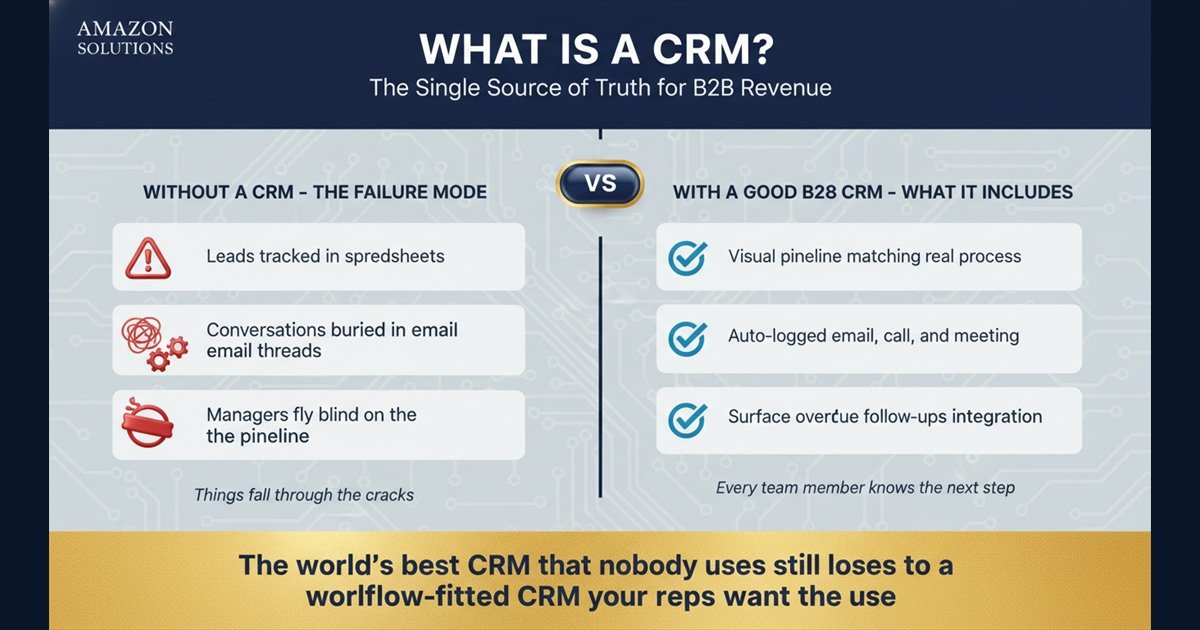
In B2B sales, deals rarely happen in a single conversation. The typical enterprise sale involves dozens of touchpoints over weeks or months — discovery calls, proposals, follow-ups, stakeholder meetings, contract negotiations. Without a CRM, managing that complexity across a team is nearly impossible. Things fall through the cracks. Reps duplicate effort. Managers have no visibility into what’s actually happening in the pipeline.
A CRM solves all of this by creating a single source of truth. Every interaction is logged, every deal has a clear status, and every team member knows exactly what needs to happen next.
What Should a Good B2B CRM Include?
Not all CRMs are created equal — especially for B2B. A good B2B CRM should include a visual pipeline that reflects your actual sales process, not a generic template. It should log emails, calls, and meetings automatically, so reps spend less time on data entry. It should surface overdue follow-ups and at-risk deals before they’re lost.
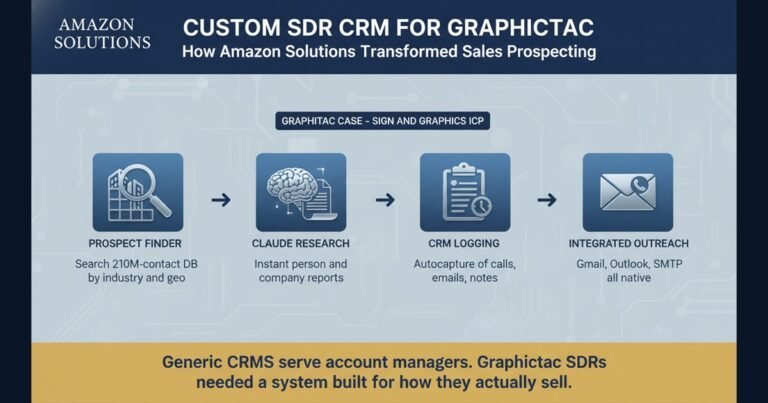
For teams doing outbound prospecting, the CRM should also integrate with contact intelligence tools — so reps can find, research, and reach out to new prospects without leaving the platform.
Why Do So Many CRM Implementations Fail?
The most common reason CRM implementations fail is simple: the system wasn’t built for how the team actually works. Off-the-shelf CRMs often require significant customization before they fit a company’s specific sales process. When that customization doesn’t happen, reps find the system more burdensome than helpful — and adoption collapses.
This is why implementation matters as much as software selection. A CRM that’s been thoughtfully configured for your workflow, trained on your process, and supported with ongoing guidance will outperform the world’s best CRM that nobody uses.
How Amazon Solutions Builds CRMs That Teams Actually Use
Amazon Solutions doesn’t just deploy CRM software — we build custom CRM systems designed around your team’s specific workflow, market, and sales process. From pipeline architecture to automation rules to reporting dashboards, every element is configured to match how your team actually sells.
The result is a CRM your reps want to use — because it makes their job easier, not harder. Ready to build a CRM that works for your team? Contact Amazon Solutions today.
$497 GEO + SEO Site Audit
Want this kind of analysis run on your site?
We map your real visibility across ChatGPT, Perplexity, Claude, and Gemini — and hand you a prioritized fix list within 5 business days.
Book Your $497 Audit →